
Oilfield Chemicals
Demulsifier Intermediate
Concentrated RIM OSD demulsifier bases for formulating high-performance oilfield demulsifiers, dehydrating chemicals and refinery desalting blends.
- Rapid Water Drop
- Clear Oil/Water Interface
- Refinery Desalting
Overview
During the production of crude oil, a multi-phase fluid is produced. Co-produced with the oil are natural gas and an amount of water, usually saline, which — as the reservoir is depleted — can be present in quite large proportions.
During the production process, the fluids experience significant shearing in different locations, including the perforated zone, the downhole pump and the wellhead. Emulsifying agents naturally present in the crude oil, such as asphaltenes and the soaps of linear and aromatic organic acids, along with solids such as clays, sand and scale, stabilize the crude oil/water interface and make the emulsions difficult or slow to separate. In most oilfield applications, the initial crude is an oil-continuous emulsion that, upon treatment, can invert to become water continuous, requiring the use of deoilers, which are covered separately.
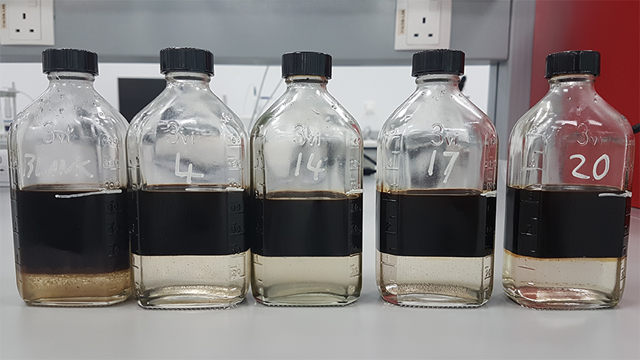
Bottle test comparing water-drop performance across demulsifier blends
Achieving Optimized Demulsification
Due to the high throughput requirement of most oilfield separation systems, gravity separation of the emulsions is insufficient, particularly if the relative gravitational difference between hydrocarbon and water is negligible — e.g., steam-assisted gravity drainage (SAG-D). Therefore, assistance is required to achieve satisfactory throughput. To achieve optimized demulsification, natural gas needs to be removed from the fluids to encourage quiescent coalescence of the emulsion. This is physically aided through heating of the oil and/or the emulsion pad, which helps melt waxes and reduce the crude oil's viscosity, allowing the water droplets to settle out more quickly.
However, by far the most common treatment to help break the emulsion is the addition of formulated chemical demulsifiers. These chemical additives are usually injected at the wellhead to achieve adequate mixing prior to the separator so that the demulsifier can reach the target interface and function effectively. To reach the surface of the emulsified water droplets, the demulsifier blend must have the right solubility. The chemical demulsifier is attracted to the emulsifying agent through differences in polarity. Once at the target, it neutralizes the effect of the emulsifying agent, allowing the finely dispersed water droplets to coalesce upon contact. As the water droplets increase in size, they tend to settle, separating the water from the oil.
The stability of an emulsion is unique to each reservoir, and may vary from well to well. As such, it is necessary to develop demulsifier blends specifically targeted at the fluids produced. RIMPRO demulsifier products should be considered as concentrated raw materials, or intermediates, for the preparation and/or formulation of oilfield demulsifiers and dehydrating chemicals. Field demulsifiers are usually blends of two or more intermediates, selected on the basis of their performance in bottle tests and centrifuge tests, the methods of which can be found in separate publications.
These tests help identify the products that produce the maximum amount of water and the cleanest oil. The samples should be examined for fastest water drop, sludging, quality of the interface, and quality of the water. The best-performing candidates should have bottle tests repeated using different combinations and concentrations until eventually the best performance blend is found.
Desalting
Another important demulsifier application occurs at the refinery and is referred to as desalting. The imported crude oil arriving at the refinery contains up to 1 percent water, which will contain significant amounts of dissolved salts. The refining process relies heavily on catalysts that will be poisoned if they are contacted by such salts, so the import crude is mixed with freshwater to remove these salts. The coalescence of the resulting emulsion is encouraged using an electrostatic grid and specialty desalting demulsifiers that yield crude suitable for refining.
Relative Solubility Number (RSN)
RSN is a useful guide in formulation that helps eliminate some of the trial-and-error involved in formulating demulsifier blends. The value assigned to each product indicates its relative solubility in water — as the numerical value increases, water solubility increases.
- Below 13: insoluble in water
- 13 to 17: dispersible at low concentrations, forms gels at high concentrations
- 17 and above: completely water-soluble
- For crude oil emulsions, a demulsifier formulation should have an RSN between 12 and 17
RSN Blending Guidelines
The following are general guidelines for the RSN system:
- RSN values combine algebraically — e.g., a 50-50 blend of RSN 10 and RSN 20 yields a blend RSN of 15
- Synergistic action between intermediates makes blends better than single-component formulations
- Very low or very high RSN demulsifiers are seldom used individually — best utilized by blending
- Blends of intermediates from different chemical groups outperform blends from the same family
- Highly oil-soluble (low RSN) polyglycols blended with oxyalkylated resins, polyols, diepoxides or polyacrylate-based intermediates have produced excellent demulsifier formulations for the oil industry
To dehydrate crude oil to a sufficient level to achieve export quality, a combination of water droppers and oil dryers needs to be used in the final demulsifier blend. While droppers may work very quickly due to flocculation of large droplets, the base sediment and water (BS&W) is usually greater than 1 percent — not sufficient to complete the job. Drying demulsifiers help reduce the water content further via coalescence of the fine emulsion droplets, though this function usually takes longer. A balanced formulation of droppers and driers is usually required to achieve target performance. Typical dropper/drying characteristics of individual demulsifiers are given below.
Rimpro India has developed many formulated products based on extensive bottle testing across most world oil zone regions, distilled into a single component so customers can select the right product easily, without requiring further technical knowledge.
The Most Cost-Effective Separation Solutions
Breaking emulsions is a critical step in the oil production process for meeting production targets, adhering to commercial crude oil specifications and yielding cleaner produced water for discharge or reinjection. Determining the most effective solution to separating emulsions is one of the most difficult projects a service company faces. Customers can count on RIMPRO crude oil demulsifier, or emulsion breaker, bases to help produce the most cost-effective solutions possible. Several important performance targets are achieved when RIMPRO intermediates are incorporated into a demulsifier package:
- Rapid water drop — quickly reduces water-in-oil to 0.1 – 0.5%
- Clear oil/water interface for easier separation
- Good dehydration of crude oil, closer to commercial specifications
- High performance in heavy oil, addressing high-viscosity issues
- High efficiency at low temperature, reducing heating expense
- Cleaner produced water for easier discharge or reinjection
Intermediate Chemistry — RIM OSD Range
| Product | Chemistry |
|---|---|
| RIM OSD A 4001 | Cross linked Alkoxylated Diepoxiside resin & Formaldehyde resin |
| RIM OSD F 4007 | Alkoxylate Nonyl-Butyl phenol formaldehyde resin |
| RIM OSD H 9000 | Ethoxylate Amyl phenol formaldehyde resin |
| RIM OSD L 9005 | Cross Linked Amyl phenol & Nonyl Phenol formaldehyde resin |
| RIM OSD M 7002 | Alkoxylate modified Mix Phenolic formaldehyde resin |
| RIM OSD N 3003 | Alkoxylate Nonyl butyl phenol formaldehyde resin |
| RIM OSD N 9003 | Alkoxylated Alkyl phenol - Nonyl-butyl formaldehyde resin |
| RIM OSD P 9100 | Alkoxylate alkyl phenol formaldehyde resin |
| RIM OSD P 9114 | Alkoxylated Alkyl mix Phenolic formaldehyde resin |
| RIM OSD R 2300 | Alkoxylated Amine Base Mix Phenol formaldehyde Resin |
| RIM OSD R 2331 | Cross Linked Ethoxylate phenol formaldehyde resin |
| RIM OSD S 3150 | Cross linked Alkoxylate Mix Alkyl phenol formaldehyde resin |
| RIM OSD S 3650 | Alkoxylated Alkyl phenol formaldehyde resin |
| RIM OSD T 9300 | Cross linked mix Phenolic formaldehyde resin |
| RIM OSD T 9393 | Cross linked Mix Alkoxylated Alkyl phenol formaldehyde resin |
Intermediate Function
All listed RIM OSD products function as dropper, emulsion breaker, desalter and treater across light, medium and heavy oil.
| Product | RSN | Dropper | Emulsion Breaker | Desalter | Treater | Light Oil | Medium Oil | Heavy Oil |
|---|---|---|---|---|---|---|---|---|
| RIM OSD A 4001 | 11.2 | |||||||
| RIM OSD F 4007 | 13.5 | |||||||
| RIM OSD H 9000 | 9.8 | |||||||
| RIM OSD L 9005 | 8.5 | |||||||
| RIM OSD M 7002 | 10.5 | |||||||
| RIM OSD N 3003 | 12.2 | |||||||
| RIM OSD N 9003 | 15.2 | |||||||
| RIM OSD P 9100 | 14.0 | |||||||
| RIM OSD P 9114 | 13.7 | |||||||
| RIM OSD R 2300 | 14.5 | |||||||
| RIM OSD R 2331 | 11.0 | |||||||
| RIM OSD S 3150 | 12.5 | |||||||
| RIM OSD S 3650 | 14.7 | |||||||
| RIM OSD T 9300 | 11.0 | |||||||
| RIM OSD T 9393 | 13.9 |
Need a custom demulsifier blend?
The above intermediates are not limited — we manufacture additional intermediates with newly developed chemistry. Details are provided upon request by email.